


Cadillac Performance Sedan Comparison
See CT4-V and CT5-V Specs Side by Side
Talk to a Cadillac Product Specialist
Schedule Your Test Drive at Camargo Cadillac
| Sales | ||
| Day | Open | Closed |
| Monday | 9:00AM | 7:00PM |
| Tuesday | 9:00AM | 7:00PM |
| Wednesday | 9:00AM | 7:00PM |
| Thursday | 9:00AM | 7:00PM |
| Friday | 9:00AM | 6:00PM |
| Saturday | 9:00AM | 6:00PM |
| Sunday | 12:00PM | 4:00PM |
Which Cadillac V Series Sedan Fits Your Daily Drive
A sedan that feels alive on a curving stretch of road but still handles a Monday commute without complaint is a specific kind of car, and Cadillac builds two versions of it. The CT4-V and CT5-V both carry the V badge, but they answer the question of speed differently, and the right pick depends on how a road actually gets used rather than which number looks bigger on a spec sheet. Shoppers researching a Cadillac performance sedan usually already know they want more than a Sport trim; what they need is clarity on which V model matches their routine, their commute, and the kind of drive they want every single day.
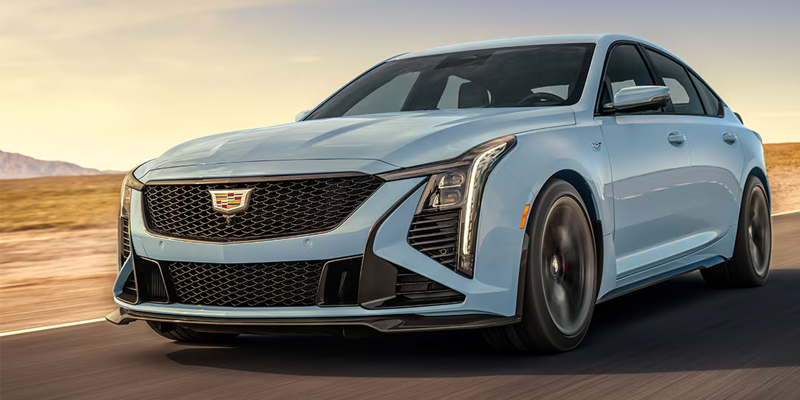
CT4-V vs CT5-V: Two Different Answers to Speed
The CT4-V runs a 2.7 liter turbocharged four cylinder that produces roughly 325 to 330 horsepower and around 380 pound feet of torque, paired with a 10 speed automatic and no manual option. The CT5-V steps up to a 3.0 liter twin turbo V6, pushing output to about 355 to 360 horsepower and 400 pound feet, riding on the larger CT5 platform with a longer wheelbase and a heavier curb weight near 4,059 pounds compared to the CT4-V's roughly 3,651 pounds. That weight difference is not just a number on paper. The CT4-V's lighter body and shorter wheelbase let it change direction with less hesitation, while the CT5-V trades some of that immediacy for a wider stance and more highway stability at speed. Pricing follows the same pattern, with the CT4-V's smaller footprint typically landing close to or occasionally above CT5 pricing depending on trim, since V series equipment adds cost regardless of engine size. The tension for a buyer is straightforward: the CT4-V rewards a driver who wants a smaller, quicker reacting car, while the CT5-V rewards someone who wants more room and a broader torque band without sacrificing the V series character.
CT5-V Daily Driving: Comfort Meets Composure
A sedan with this much output still has to survive a school run, a highway merge, and a parking garage, and this is where the CT5-V separates itself from a stripped down track car. The added length brings more usable rear seat and trunk space than the CT4-V, which matters for anyone who occasionally carries passengers or cargo alongside a spirited weekend drive. The 10 speed automatic keeps shifts smooth in normal traffic while still holding gears longer under throttle, so the transition between commuting and pushing the car does not require a manual mode switch to feel natural. Fuel economy sits in the high teens to low twenties combined depending on drivetrain, a reasonable tradeoff for a twin turbo V6 that still needs to cover regular mileage between weekend drives. The daily question is not whether the CT5-V can be quick; it is whether the ride stays composed over rough pavement and long stretches, and the larger chassis generally absorbs more of that harshness than the shorter CT4-V.
Handling Character: How Each V Series Feels on the Road
Horsepower numbers get attention, but handling character is where these two cars actually diverge as driving tools. The CT4-V's shorter wheelbase and lighter nose give it a quicker turn in response, useful on tighter roads where a driver wants immediate feedback through the wheel. The CT5-V, carrying more weight over a longer platform, trades some of that quickness for a more settled, planted feel at highway speed and through sweeping curves, which many enthusiast comparisons point to when discussing high speed stability. Neither approach is better in an absolute sense. A driver who spends more time on winding two lane roads may prefer the CT4-V's agility, while someone covering long highway stretches to work or on weekend trips may find the CT5-V's stability better suited to how the car actually gets driven.
Choosing Between the Two: What Decides It
Once the specs are on the table, the decision usually comes down to a short list of practical checkpoints rather than another round of horsepower comparisons:
- Cabin size needed for regular passengers or cargo, where the CT5-V holds a clear edge
- Preferred driving feel, quicker and lighter versus larger and more stable at speed
- Price gap between trims once options and drivetrain choice are factored in
- Fuel economy expectations across weekday driving versus occasional weekend runs
Working through those four points against a real weekly routine, rather than a spec sheet in isolation, tends to point buyers toward the right car faster than continuing to compare horsepower alone.
Driving That Fits Your Standard
Both the CT4-V and CT5-V prove that a Cadillac can deliver genuine driving character without giving up the composure needed for regular use, but they reach that balance from different directions. The choice is less about which car is objectively quicker and more about which balance of agility, room, and ride quality matches the roads a driver actually covers each week. Test driving both back to back, ideally on the same stretch of familiar road, remains the clearest way to feel that difference rather than read about it.
What interior features come standard on the Cadillac CT4-V compared to the CT5-V?
The CT4-V comes with leather seating surfaces and V series specific trim accents as part of its standard cabin, while the CT5-V builds on that same foundation with a larger cabin footprint that allows for more generous rear seat materials and additional soft touch surfaces throughout the back seat area.
Are the CT4-V and CT5-V equipped with the same driver safety features?
Both models share the same core restraint system architecture, including front and side seat belts built to the same federal safety standard, though buyers cross shopping a specific model year should confirm equipment lists directly since minor changes have occurred across recent CT4-V production years.
How does the CT5-V's 3.0 liter V6 compare to the standard CT5 Premium Luxury engine?
The CT5 Premium Luxury runs a smaller displacement engine tuned for everyday commuting, while the CT5-V's twin turbo 3.0 liter V6 adds roughly 100 additional horsepower and a noticeably stronger torque curve, which is the primary reason the V badge carries a higher price than the standard CT5 lineup.
Where can I see and test drive a CT4-V or CT5-V near Cincinnati?
Camargo Cadillac's Montgomery Rd location in Cincinnati keeps both V series sedans available for side by side test drives, which remains the most direct way to feel the handling and cabin differences described throughout this comparison.
(Note: This article focuses on providing valuable information and does not mention specific pricing, for more information about financing and car buying, please reach out to our dealership.)